Showing posts with label social media. Show all posts

Sunday, July 12, 2009

compelling supporters to join your fight

The New York Times' Nicholas Kristof has been on a roll lately with his columns about the right — and the wrong — way for charitable organizations to compel supporters to join them in the fight to meet their mission.

Earlier this week he argued, as he had in 2007, that the public is more compelled to get involved if they see themselves as saving one person — one cute kid, one mother who has persevered — versus the millions who may find themselves in the same situation.

"There’s growing evidence that jumping up and down about millions of lives at stake can even be counterproductive. A number of studies have found that we are much more willing to donate to one needy person than to several. In one experiment, researchers solicited donations for a $300,000 fund that in one version would save the life of one child, and in another the lives of eight children. People contributed more when the fund would save only one life."

People want to feel good. They don't want to think about the enormity of a problem that they can never truly solve. They want to write a check and believe they have had an impact.

Quite a few well-meaning people who see themselves as experts in issues marketing did not take too kindly to Kristof's comments. They'll have to get over themselves.

Yesterday, Kristof praised the marketing efforts of Scott Harrison, the founder of charity:water, an organization that has raised $10 million in the past three years from 50,000 individual donors and has provided clean water to one million people in Asia and Africa.

Why does Kristof think Harrison been successful?

  1. He can assure new donors that every sent they send will make it to the field. He can do this due to the support of 500 of his "most committed" supporters, who pay to cover all administrative costs.
  2. Donors can see the impact of their work. They can name wells and get the GPS coordinates to identify their wells on Google Maps.
  3. Finally, charity:water has, creatively, embraced social media.
Assure your donors they're money is being spent effectively, allow them to see how they have made a difference and use social media to help facilitate building relationships with your supporters and tapping into their networks.

Thursday, January 01, 2009

best practice for blog commenting protocol


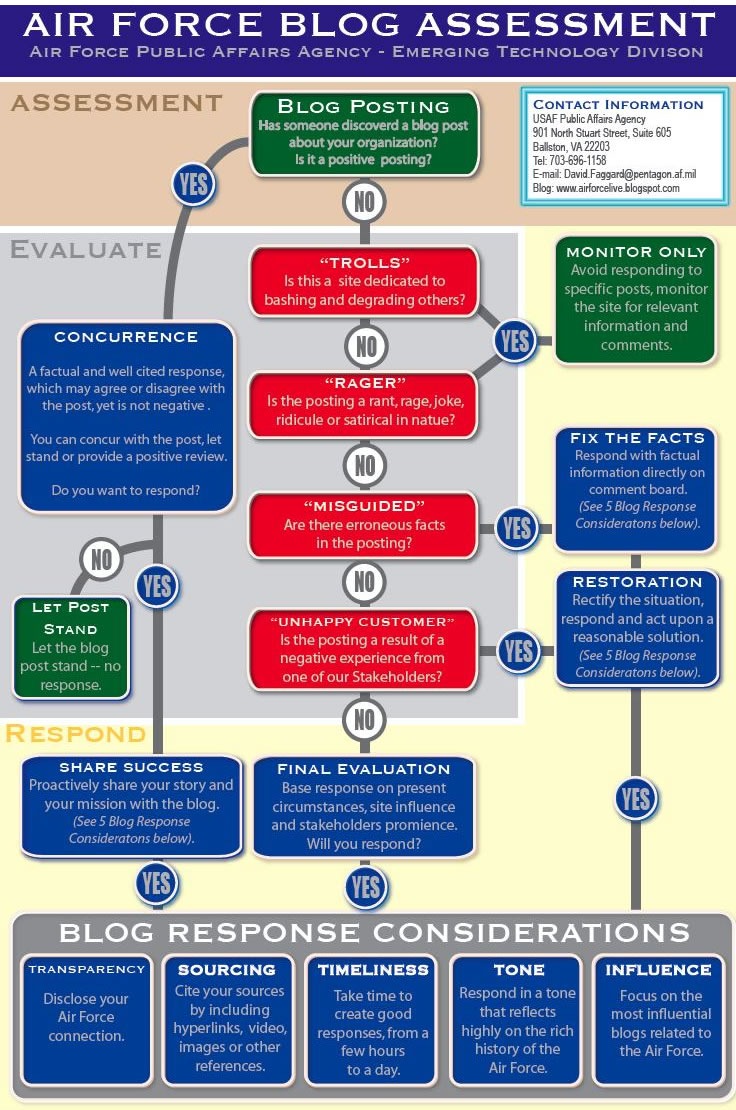
Joey DeVilla at Global Nerdy posted this blog commenting protocol from the United States Air Force yesterday. (It came to me via Dave Armano on Twitter.)

It's a super simple way to communicate the information that I have been sharing with clients via "commenting protocols," which are tailored guidelines for who, when, where, why and how to respond to brand mentions online.

These documents are generally a few pages long and I've never been confident that they really get shared and absorbed throughout the client's company or group in a way that I would like them to.
If the client still wants the detail that comes in the commenting protocol, we can provide that to them, but this style of document makes sense for them to have to share internally to really get people on board. It's easy to understand and easy to share and can still be tailored to the client's specific situation/brand message.

Monday, December 01, 2008

get a personality

One of the oft repeated tips for a successful blog (so 2005) was that you should try to be consistent and stick to one topic. The thinking was that your readers would come to rely on you as a resource for your area of expertise, whether it was social media, knitting or fan girldom.

Well, that tip should be tossed out the window when you are using Twitter. While you can establish yourself as a great resource for a particular topic, the "best" Twitter users are those who take advantage of the medium to let their true personalities come out.

Sure, you're a marketing genius. But you're also a dad or a mom who likes Fraggle Rock and rides motorcycles and sings karaoke on the weekend — at least when you're not baking blueberry muffins, getting a new tattoo, remodeling the bathroom, traveling to yet another conference or client meeting or drawing cartoons on the back of business cards. You like Nick Cave or you drink too much scotch or you have an unhealthy obsession with Mad Men. You get angry, you get excited, you laugh at bad YouTube videos and you occasionally just need to put the blinders on and get some work done.

In other words, you're human, you're worth rooting for and you're worth tuning into to hear what happens next.

I submitted this tip at Twitter for Dummies.

Saturday, November 22, 2008

The President-Elect's Social Media Grade - So Far

Barack Obama, since winning the Presidential election, has indicated that social media will be a part of his presidency, just as it was a part of his presidential campaign.

In the 18 days since he was elected, he has launched Change.gov, the Web site of "the Office of the President-Elect" and has done two weekly addresses via YouTube on the ChangeDotGov channel.

So, how is he doing?

Change.gov/Grade = B -

The most impressive part of Change.gov is the speed with which it was launched, just two days after the election, on November 6. But what about the content?

Positive:
1) It has a blog that is updated almost daily and often multiple times per day, meaning the site is giving a reason to users to keep coming back. (You can sign up for an
RSS feed for the blog.)
2) The blog posts incorporate video from the ChangeDotGov YouTube channel, as well as photos, making it (albeit slightly) more visually compelling.

Negative:
1) The blog does not accept comments which, as far as I am concerned, means that it's
NOT a blog and is instead simply a series of press releases written in more conversational tone and listed in reverse chronological order. Boo.
2) While the site encourages visitors to submit their comments on agenda issues , these comments are not able to be seen by other visitors to the site. In fact, it's unclear what will become of the comments. What then, is the motivation to submit? Peter Kim recently wrote on his blog that the incentive for social media participation is the "activation of the feedback channel - that others agree, disagree, share, favorite their content." What is the incentive when the content seemingly falls into the abyss, never to be heard from again?
3) This same sense of an "abyss" applies to the site's "An American Moment: Your Story" feature. What are they going to do with this content?

ChangeDotGov YouTube Channel/Grade = B-

Barack Obama is alternately being compared to Abraham Lincoln and Franklin Delano Roosevelt — pretty good company to keep. The FDR comparison was only heightened with the launch of Obama's "Weekly Address from the President-Elect," which is being compared with the former President's Fireside Chats, which were used to provide comfort and motivation to the country in the midst of the Great Depression.

Positive:
1) Posting content to YouTube encourages its viral spread, particularly because of the feature which allows users to cut and paste code to embed it on their blogs, social network profiles, etc.
2) The "Inside the Transition" videos from transition team members, particularly the video from Heather Zichal, a member of Obama's Energy and Environment Policy Team, are great. Heather responds directly to comments that have come in on Change.gov (so,
THAT's how they're being used), helping to communicate that the new administration really just might be listening.

Negative:
1) Both comments and ratings have been disabled. Is someone afraid of a little honest feedback?
2) Barack Obama is a great speaker. There's no doubt about it. But his style in these Weekly Addresses is all wrong for the medium. I know, I know, he's President-Elect and he needs to present himself as "presidential." But we already let him know that we think he's presidential by electing him to the Office. Now we're counting on him to change what that means. Obama? Yeah. Relax a little and come out from behind the desk. Give us a reason to want to share them with our friends — our friends who don't suffer from insomnia.

Do you agree that Obama could be doing better with his social media efforts?

4 Reasons Why Obama Should Still Engage in Social Media


Barack Obama is being called our "first social media President" due to his use of online word of mouth marketing to be elected President of the United States. Those of us who have been proselytizing about social media to our clients and colleagues simultaneously feel an inevitable sense of validation and a tinge of fear (and frustration) as clients feel inclined to ask, "Why can't we do what Obama did?"

(Folks, Obama's marketing campaign cost $640 million and had the key ingredient of any successful word of mouth marketing campaign: a really excellent "product" with a great story to tell.)

But now what? How can he continue to engage with social media successfully once he is in the White House — and should he?

Four Reasons Why Barack Obama Should Continue to Engage with Social Media

Number One: The 2012 Election is Already Underway

The 2012 Presidential election started on November 5, maybe even the moment that Barack Obama took the stage with his family in Grant Park. He is going to need money and the same grassroots infrastructure to get reelected and there's no time like the present to get started.

Number Two: Young Voters

Young voters have disproportionately voted for Democratic candidates in the past two presidential elections and the Republican Party, as it focuses on rebuilding itself following its huge losses in this year's election, is likely to be investing in strategies to engage young people and sell them on the Republican brand. To retain their support, Obama, with millions of young people already in his camp, must rely on young voters to engage their peers — and younger siblings and friends — as word of mouth ambassadors by reaching out within their social networks on his behalf.

Number Three: His Network Makes Him Stronger

November 5 was not only the start of the 2012 election for President, it was the start of the 2010 congressional election. Obama's former colleagues in the Senate and House would love to have the support (financial and grassroots) of Obama's network. Knowing that it remains intact — and, perhaps, is growing in size and strength — gives Obama a powerful bargaining tool and people to call on and mobilize when he needs a helping hand to see his policies through.

Number Four: He Has Created Expectations that He Needs to Live Up To

When I talk to people about social media, I explain to them that I think social media has contributed to and is reflective of a change in the relationship between consumers and the brands with which they do business. Consumers have expectations that brands need to live up to to be successful:

1) consumers want brands to listen to them,
2) they want brands to be honest and transparent, and
3) they want brands to provide them with the opportunity to help them achieve their missions.

Obama, as a brand, lived up to each of these expectations, in part through the use of social media. If he turns his back on them now, by demonstrating that he is no longer willing to listen, to let them in, and to involve them in creating "the change we want to see," he will lose them and he will have demonstrated that "change" was nothing more than a campaign slogan.

Do you have any reasons to add to the list — or do you think Obama should shut down his Twitter account now that he's heading to the Oval Office?

It looks like he has already made that decision . . .

Friday, July 04, 2008

people aren't going to talk about you

I've grown more willing to tell clients that they can't expect to generate positive word of mouth about their brand or product or issue if it, well, sucks. I mean, there will word of mouth (actually, there probably already is), but it will essentially be warnings to their friends, family members and co-workers to stay the hell away.

But there's more to it, says Seth Godin (in this post from way back in May).

Smart but simple; the kind of post that, if this was a slapstick comedy, would compel me to smack myself in the forehead — the universal signal for "duh."

People aren't going to talk about your product or service if . . .

  • it's embarrassing,
  • it's not cool,
  • they're not sure if it's cool,
  • it's SO cool, they don't actually want other people to know about it,
  • too many people already know about it, or
  • your values conflict with their own.
Just one more reason why social media, no matter how shiny and fabulous, should not be seen as the answer to all that ails you.

Thanks, Seth.

Crossposted on the agency blog.

Monday, May 12, 2008

del.icio.us tags: brands

Noah Brier has launched brand tags, collecting tags to assess people's perceptions of a wide number of brands -- from Burt's Bees to Jamba Juice. You can request that additional brands be added, so if you're looking for a little insight on a client brand — or your own, you might be in luck. Noah might want to adjust the size of the tags (I'm guessing he had no idea how popular this would be) because "smoothie" and "beard" are going to grow bigger than the browser.

Dave Alston from Radian6 guest posts on the Online Marketing Blog with a list of the Top 10 Reasons for Monitoring Brands in Social Media. As a fan of Radian6 who is trying to bring the tool to more of our clients, I appreciate Alston's comment, "Choosing not to listen doesn't make those conversations go away."

Southwest has expanded upon its successful blog, Nuts about Southwest. The site now incorporates their Flickr group, video blog, aggregated news, polls (lame) and the brand's social network profiles, including Twitter.